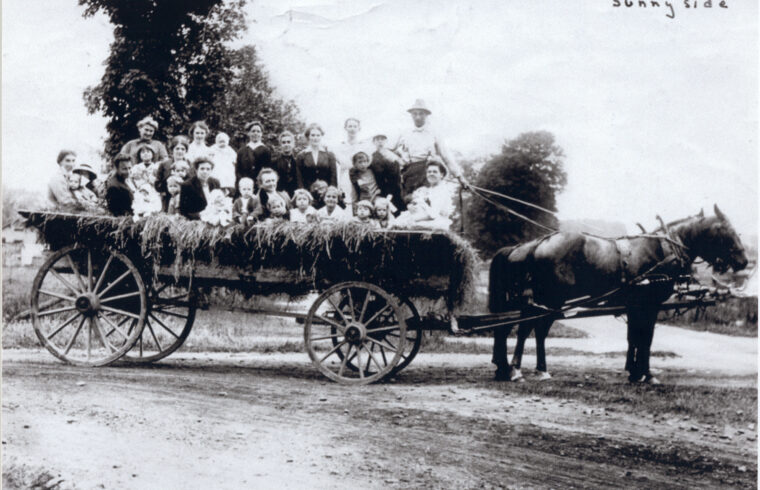
 A horse-drawn carriage brings kids to Moorelands Camp in Dorset in the early 1900s. /submitted
 By Emily Stonehouse
eep in the woods of Dorset, there is a magical place.
A place where kids can be kids, where the pressures of the real world can be shed, and the joy of community connections and lifelong friendships are given a space to flourish.
And it’s been changing lives for over 100 years.
Moorelands Camp first formed in 1917, and moved to Kawagama Lake in 1972. This leadership camp provides a safe space for kids to step out of their comfort zones, and unplug from their digital devices to reconnect with nature. Through interactive activities that include kayaking, high ropes, archery, sports and much more, the key leadership elements of developing responsibility, decision making and critical thinking are woven throughout each activity.
“And our vision mission has never changed,” said Colette Halferty, the director of development and communications for the camp. “Serving low income families from low income communities. Those who wouldn’t be able to go to camp.”
Based out of Toronto, Moorelands Kids started in 1912. The idea of the program is to work with under-privileged youth, to develop leadership skills and tangible, hand-on life experiences that would support them in the real world. “By design, our intentional programming meets kids where they are at,” said Halferty, “and empowers them to recognize their own potential to grow and develop life and leadership skills that can strengthen their emotional and social well-being.”
The programming is offered year-round, and designed to build and develop skills that are not traditionally taught in schools. “We invest in kids by way of teaching attributes and soft skills that are transformative and life-changing in terms of their sense of self-respect, relationships built on mutuality and respect of others, and team building,” noted Halferty.
Moorelands Camp is an expansion of these teaching methods, but in a different place, with different people. With the camp only accessible via boat, kids start their journey to Moorelands already outside of their comfort zone. “It’s a bit of a magical experience,” chuckled Halferty. Currently, the camp has the capacity to support 600 campers over the course of the summer, with a dedication to keeping the camper to staff ratio at two campers per counsellor; ensuring safety and support is top of mind.
Halferty noted that it is a device-free camp. “It’s all about real face time,” she said. “There is a commonality to our campers. Everyone is coming together under very similar challenges.”
Historically, the camp has attracted kids from city centres, but the staff at Moorelands are aware of the poverty levels within Haliburton County, and hope to welcome more local kids into their accessible programming. “Poverty is on the move,” said Halferty. “And we want to create safe, fun places where kids can really thrive.”
The programs at Moorelands Camp are designed for ages eight to 16, with many campers returning year over year. Halftery referenced one camper who came many summers in a row; gradually building her confidence and drive each time. By the time she aged out from the camp program, she had her path in life paved forward, and followed through with a career in nursing, before returning to the camp to work as an on-site nurse. “It was a very full circle moment,” said Halftery.
Other campers expressed similar sentiments. “My favourite part of camp is definitely getting to meet new people,” said Mariah, a camper in 2023. “After my first year at camp, I was still kind of nervous, but it is a good feeling that I get to make new friends every summer. We learn leadership skills, like taking responsibility for ourselves. We learn to reflect on our actions and how they affect others.”
While Halftery can’t pinpoint the exact number of campers who have been to Moorelands over the years, she knows that the programming has helped “hundreds of thousands of kids.” The camp does not receive any government funding for their programming, and is entirely supported through fundraising. With the model in mind that every kid deserves to be a kid at camp, the organization follows a subsidized scale, which indicates where campers fall into for their costs. “We want to meet kids where they are,” said Halfterty. “So that way, they’re not going against another stigma. We do everything we can to make it so that they can be a kid.”
Information on Moorelands Kids programs as well as Moorelands Camp can be found at www.moorelands.ca, as well as options for donations. “Kids are our future,” said Halfterty. “We want to give them all the tools they need to thrive.”