

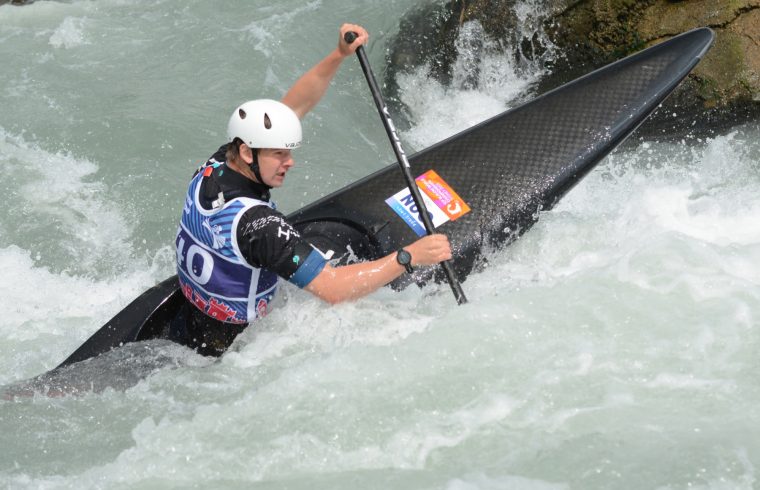
 Whitewater kayaker Ryker Harris paddles in the ICF Slalom World Championships held in Sydney, Australia in 2025. Originally born and raised in Huntsville, Ontario, Harris and his family have recently moved to Minden for easy access to practice at the Minden Whitewater Preserve. The athlete is eyeing to be a contender for the 2028 Summer Olympics, with aspirations of competing in the 2032 Summer Olympics in Brisbane, Australia.
By Thomas Smith
Born and raised in Huntsville, Ryker Harris first got on a boat at a summer camp when he was eight years old.
“At first I felt a lot of fear,” said the young paddler. “But I felt really excited as well. You don’t see a lot of people whitewater kayaking. It turned out to be a lot of fun.”
In 2019, Ryker competed in his first large competition at the 2019 National Championship held in Minden.
Two years ago, at just 15-years-old, Ryker decided to focus all of his efforts into becoming a professional whitewater paddler. His father, Bryan, noticed a change in Ryker’s mentality when he chose to not eat pizza for dinner one evening
“As a parent you guide your kids and teach them to listen to their coaches, eat right,” said Bryan.
“Especially when I slowly got access to resources, people started helping me a lot and I started to believe that I could really do this,” added Ryker.
Soon after this change, the paddler was invited to his first overseas whitewater training trip in Australia.
Ryker’s training became a full-time effort, with his hunger growing for winning competitions. “When he got serious, his mom and I asked him, what is it that you love so much about this sport,” said Bryan. “He said I love being able to control something that is so out of control.” Ryker’s training days start with an early morning and a meditation session. Hearing a motivational speech for the day, he eats breakfast, takes a bus to school and attends for two periods. Returning home, he has a snack, does a gym workout or flatwater session, eats a full meal for lunch and then knuckles down for two more hours of school work.
After school work, his brother Gryffin, a talented whitewater paddler as well, joins him to do some whitewater paddling together.
After eating dinner, he says he collapses around 10 p.m.
The brothers participate in a variety of whitewater paddling styles including C1 slalom, K1 slalom, and Kayak Cross.
To whitewater paddle, the athlete kneels in a kayak that is four to five metres long. It is a competition of time as paddlers race to the finish line at the bottom of the river.
In K1 slalom events, athletes use a double balded paddle, whereas a single balded paddle is used in C1 slalom events. In kayak cross events, four paddlers compete to get to the finish line before the others. In all of the events, paddlers are sprayed with water and navigate with their paddle and by shifting bodyweight. The term slalom refers to the paddler having to navigate themselves through indicated gates.
For prolific whitewater paddler and Ryker’s coach, Tren Long, he describes kayak cross as a combination of a martial arts discipline and paddlesport.
For onlookers, it makes quite the spectacle. It is also a recent addition to the Olympics, first introduced as an event in the recent 2024 Summer Olympics held in Paris.
Travelling with his coach to Australia, Ryker was the youngest competitor at the 2025 ICF Canoe Slalom World Championships held in Sydney. Over the course of his paddling journey, he has competed in Brazil, Spain, France, Poland, and the United States.
“That was a nice step into being alone,” said Ryker. Having to cook and do laundry for himself, Ryker said that travelling alone accelerated his independence as a young man.
The night before every race, Ryker creates a race plan. Routine helps him get into the race mindset, with each breakfast before a race being scrambled eggs. His warm up is 30 minutes before, with visualization taking place on the water in his boat.
“I always visualize a perfect run. As soon as you get a bad move in your head, you put it in the run and it becomes a reality,” said Ryker. “By making myself have a good run in my head, I can perform that on the water.”
While he has competed in many competitions, Ryker says he still feels nervous at the starting line.
“I try to never forget why I am there to compete,” he said. “It’s because I love it.”
Racing against other athletes, Ryker says that he loves the chase of the win.
“My biggest motivation is working hard,” he added.
Ryker’s motto is that pressure is a privilege. Working so hard to qualify for competitions, he describes his nerves as an ‘amazing feeling’ justified by his drive to compete at the highest level.
Throughout his journey, Ryker was always drawn to the Minden Whitewater Preserve. A place where he could whitewater kayak, it has proved invaluable for his training.
During the paddling season, his family would often temporarily reside in an RV at the Whitewater Preserve to offer their sons immediate access.
This year, the Harris family decided to relocate from Huntsville to Minden fulltime.
“I am excited to have moved here and am training full-time,” said Ryker.”I would say the Minden Whitewater Preserve has maybe the best course in Canada for slalom.”
He says that training at the Minden Whitewater Preserve gives him an advantage competing worldwide. Living close by, he can complete whitewater runs within an hour of paddling from his family’s home.
The Minden Whitewater preserve is an internationally known course for kayak slalom athletes. Most recently, it hosted the Pan American Games in 2015.
“I feel that training here gives me a lot more experience on artificial courses,” said Ryker.
At the age of 17, Ryker is aware that his experience is different from other youth his age.
“I do not miss my high school experience,” he said. “I came into this sport and I felt the freedom. I am super grateful and appreciative that I can have that now. It brings a lot of enjoyment to my life and I think I like it more than when I was in high school.”
Beyond the course, Ryker says that the paddling community around the world welcomes him with open arms.
“No matter what, the people in this sport are amazing,” he said.
This past year, Ryker competed for the Junior National Team in the C1 Men and Kayak Cross divisions.
So far, his biggest struggle has been balancing his coursework with training.
The other struggle is competing in Europe with international kayak slalom athletes.
“There is a big jump in going from the junior team and competing in the world championship. You realize there are much higher levels in this sport. It is quite humbling going overseas,” said Ryker. “When you come back to Canada, you realize that you need to work way harder than everybody else.”
Ryker has already qualified to be an instructor with Canoe and Kayak Canada. His next goal is to become a part of Canoe and Kayak Canada’s Senior Team to compete for Team Canada. With joining the team, Ryker would get access to funding to pursue his beloved sport into his adulthood.
“The senior cards are given if you make semi-finals or finals at World Cups and Senior World Championships,” he said.
Ryker has seen paddlers qualify for World Cups aged in their 40s.
At 17-years -old, he knows that his journey as a whitewater kayaker is just beginning. As an instructor, he wants to show the sport he loves to others, especially young kids.
He is currently eyeing to be a contender for the 2028 Summer Olympics, with the whitewater course hosted in Oklahoma.
Ryker asks that anyone that has an interest in the sport, or kids who may be interested, to come and visit the Minden Whitewater Preserve during events and speak to paddlers. The community is highly welcoming and they want more youth to participate in whitewater paddling.
While still training, another dream of Ryker is competing in the 2032 Summer Olympics that will be held in Brisbane, Australia.
Looking back, Ryker says that if he could talk to his younger self, he would assure him that he still loves the sport of whitewater kayaking.